

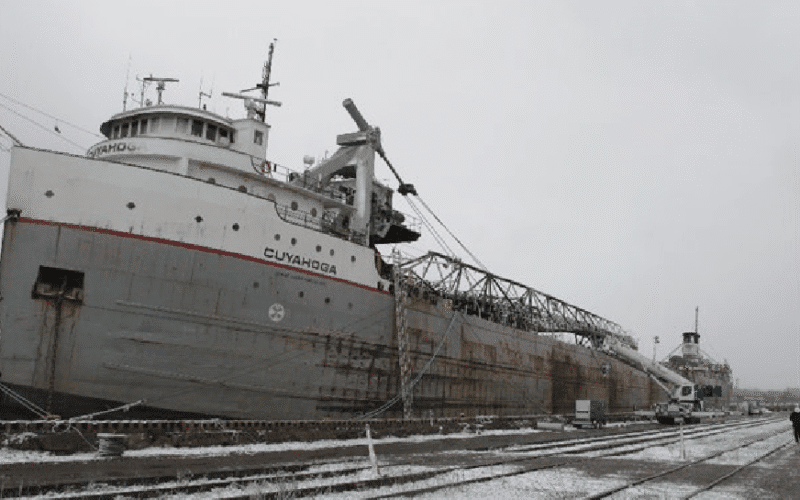
(WASHINGTON) — On March 18, 2025, about 1600 local time, the bulk carrier Cuyahoga was discovered partially flooded while docked on Lake Erie in Ashtabula, Ohio. There were no injuries and no pollution was reported. The vessel was dewatered and refloated. Salvage costs were undetermined; the vessel had previously been declared a constructive total loss as a result of extensive damage sustained during a fire in March 2024.
The National Transportation Safety Board (NTSB) determined that the probable cause of the flooding was water ingress in the engine room from the main engine and generator water cooling systems’ duplex strainers – which were uncovered while the vessel was in layup status – possibly due to the failure of the systems’ closed sea chest valve.
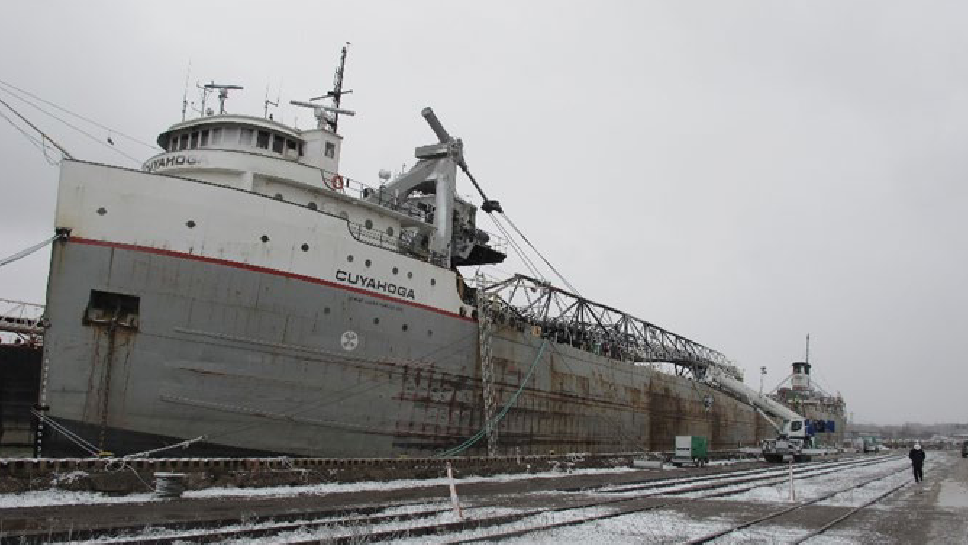
“While the self-unloading bulk carrier Cuyahoga was docked in Ashtabula, Ohio, in winter, in cold layup status, and awaiting disposal as a result of extensive damage from a fire a year earlier, flooding was discovered within the vessel’s engine room,” the NTSB reported stated. “The flooding caused the vessel to sink and contact the bottom while moored to the pier.

“During the salvage of the Cuyahoga, divers confirmed that all of the sea chest valves, which isolated the vessel’s sea chests from their respective downstream piping systems, were closed. As they investigated further, the divers discovered that lake water was entering the engine room through uncovered duplex strainers for the main engine and generator cooling system(s),” the report continued. “These strainers were located downstream of the sea chest valve. Once the covers and drains to the duplex strainers were closed and secured, the water ingress ceased, and the vessel was able to be refloated. This indicates that although the sea chest valve supplying the main and generator engine cooling water systems was closed, lake water was still able to enter their piping (see graphic above). However, because the investigation into the flooding was limited and the vessel was scrapped, the exact cause of the water flowing in the system could not be determined. It is possible that the valve disk or the valve seat failed while the vessel was in cold layup, which would have allowed water to flow into the uncovered duplex strainers and out to the engine room.”
Click here to read the complete report.
– National Transportation Safety Board
