

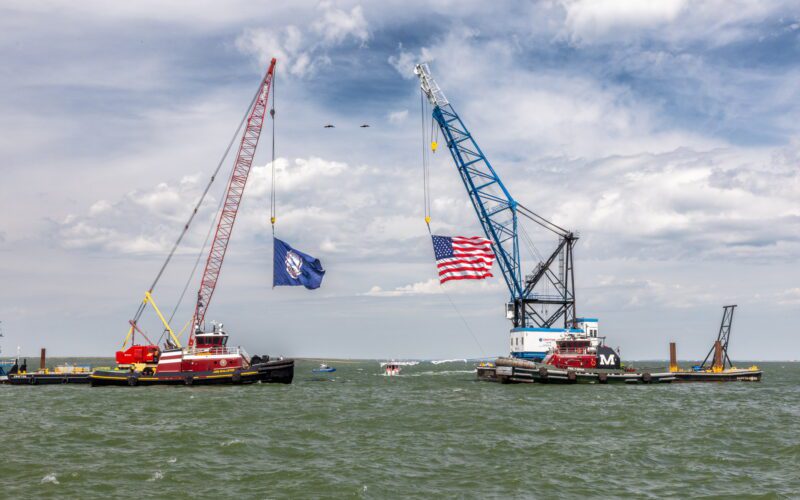
(NORFOLK, Va.) — With an audience of more than 200 people gathered Thursday at Norfolk International Terminals, Virginia Gov. Abigail Spanberger inaugurated the Port of Virginia’s newest asset: the deepest harbor and shipping channel on the U.S. East Coast.
Though the $450 million effort to deepen the channel to 55 feet was complete in February, the governor introduced the project to the world Thursday.
“Today, we are sending a clear message to the entire world: The Port of Virginia is wide open for business,” Spanberger said. “The port is now home to the deepest commercial shipping channel on the entire East Coast of the United States. Because of this investment, the largest cargo ships in the Atlantic trade, and the next generation coming behind them, can now safely transit Norfolk Harbor with a full load.
“This project allows ocean carriers to load more Virginia agricultural and forestry exports than ever before, soybeans, wood pulp, and lumber, keeping shipping costs down and keeping our farmers competitive on the global stage. And when manufacturers are deciding where to relocate, they will have the peace-of-mind knowing that their goods can be moved reliably and efficiently.”
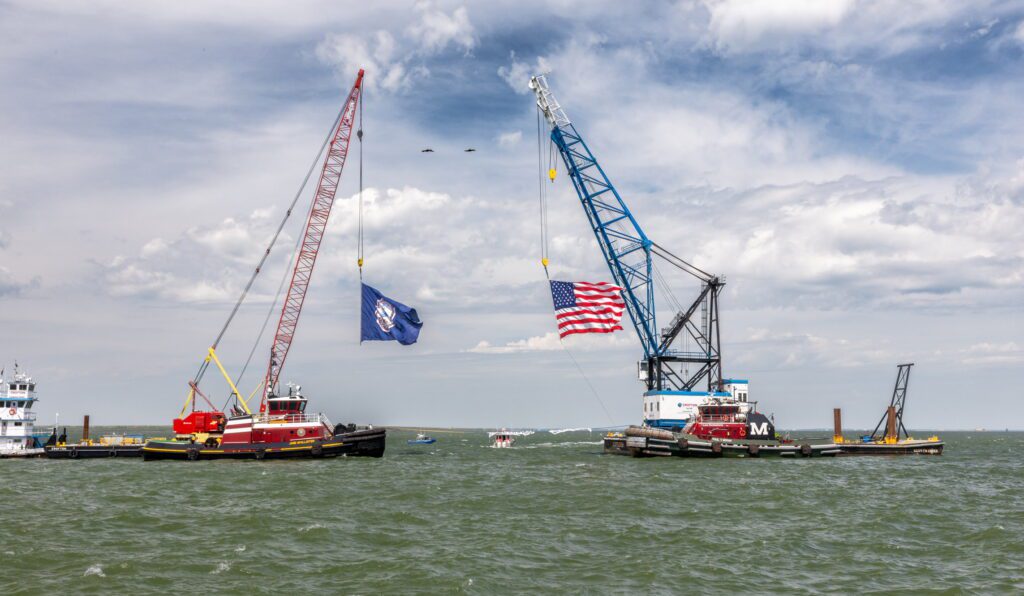
The deepening was substantially completed Feb. 28, with ongoing maintenance and cleanup efforts being conducted by the U.S. Army Corps of Engineers. Once all support work has concluded, with the expanded and deepened channel surveyed and depths verified, maritime charts will be update to reflect the increased capacity.
The dredging project also included widening areas of the channel, which allows for two-way traffic of ultra-large container vessels (ULCVs). The widening project was completed in February 2024.
Virginia Port Authority CEO and Executive Director Sarah McCoy said the port’s assets – modern terminals, 21st-century cargo conveyance systems, on-dock, double-stack rail, overall growing efficiency and expanding berth capacity for ULCVs – combined with deep, wide channels position the port for the future.
“Delivering projects like the 55-foot channel are important today, but the real value of what we are doing is how it positions us for the future,” McCoy said. “With all of our foundational elements in place, we are assuring our customers and port users that they will be able to expand their operations and cargo volumes at the Port of Virginia without concern for outgrowing our capabilities. We’re prepared today for the demands of decades to come.”
The dredging project is a foundational element of the Gateway Investment Program, a capital construction campaign that started in 2023. The program’s projects are:
• $450 million: Deepening the channel/harbor and widening it to ensure safe, two-way ULCV passage – dredge work is complete.
• $83 million: Expanding the port’s annual rail capacity to 2 million TEUs – fully operational.
• $220 million: Converting Portsmouth Marine Terminal, a legacy container terminal, into a deepwater heavy-lift facility – fully operational.
• $650 million: Renovating and reconfiguring the North Berth at Norfolk International Terminals – construction is past the halfway mark with completion scheduled for mid-2027.
The North Berth modernization and expansion project includes four new low-profile ship-to-shore cranes, a reconfigured container stack yard and an expanded technology backbone. When the North Berth work is complete, the port’s annual throughput capacity will be 5.8 million TEUs. Moreover, when the North Berth opens it will allow the port’s fifth ULCV berth to come online.
McCoy said the success of the project has been driven by the long-term support it has received from Virginia’s congressional delegation, the Virginia Legislature, the Norfolk District of U.S. Army Corps of Engineers and the Virginia Maritime Association (VMA).
“We absolutely would not be here today if it weren’t for the perseverance of our elected leaders at the federal and state levels, the U.S. Army Corps of Engineers’ Norfolk District office and the VMA,” McCoy said. “From the beginning, this (dredging) project received widespread support and Virginia’s leaders in Washington, D.C., were integral to its success. Our congressional delegation played a critical role in helping us to understand and navigate the process to secure funding and keep the project moving forward.”
The dredge work began in December 2019, nearly two and a half years ahead of schedule. The port’s preparation for the project, its collaboration with the Army Corps of Engineers, the support of elected officials and the state’s willingness to fully fund the project ahead of the federal investment were factors behind the early start of construction.
– Virginia Port Authority
