


(CLEVELAND) — A little over a day and half since the Soo Locks opened, providing access to Lake Superior and critical raw materials like iron ore, the U.S.-flagged Great Lakes commercial fleet is at a standstill in the St. Marys River and Whitefish Bay, the critical connection between Lake Superior and all other Great Lakes.
The only way into Lake Superior is through the St. Marys River and Whitefish Bay. Unfortunately, ice conditions and a lack of a heavy U.S. Coast Guard icebreaker are creating substantial delays for American shipping and manufacturing. Some U.S. shipping companies have suffered more than 24-hour delays, and the clock keeps ticking.
With Mackinaw, the only heavy domestic Coast Guard icebreaker, unable to lock up to Whitefish Bay (due to an engineering casualty) where ice conditions are in excess of 2 feet in spots and covered by 3 feet of snow, U.S.-flagged lakers remain locked in ice. A capable icebreaker from Canada was deployed to the area but abruptly departed to care for a couple of Canadian ships going to Thunder Bay, Ontario. Meanwhile, the system remains essentially closed, with U.S. vessels trapped in the lower St. Marys River and Whitefish Bay. No ship has passed downbound from Duluth at this point and no cargo has been delivered to the steel mills on the southern lakes.
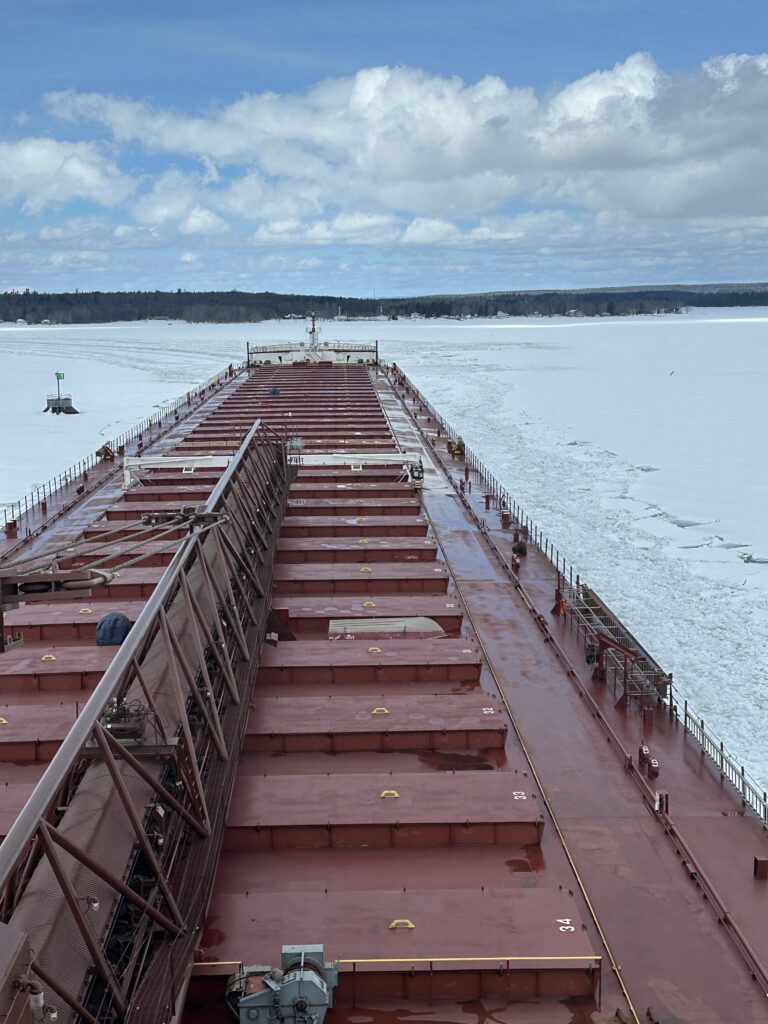
“The Lake Carriers’ Association (LCA) has pleaded with Congress to get another heavy U.S. Coast Guard icebreaker on the Great Lakes, but unfortunately funds have been slow to come. I don’t understand the Canadian Coast Guard taking care of a few vessels bound for a port that has commercial icebreaking assistance available and abandoning critical shared waterways like the St. Marys River and Whitefish Bay. Now the system is shut down,” said Jim Weakley, president of the Lake Carriers’ Association.
The early opening of the St. Lawrence Seaway and Welland Canal simply put greater demand on a mission that is not adequately resourced, according to the LCA. Prioritization of Canadian vessels and Canadian ports comes at the expense of American Lakers and American ports.
While the southern Great Lakes are mostly ice-free, conditions to the north are extremely difficult, requiring a heavy icebreaker in multiple locations. U.S. manufacturing like steel production continues to feel the pain of an inadequate U.S. Coast Guard icebreaking fleet. As witnessed over the past day, depending on the Canadians to move U.S. cargo is not a reasonable expectation and definitely not in the best interest of the U.S. economy, the LCA said. Both Coast Guards claim to take a “one mission” approach to Great Lakes icebreaking, but there is an old saying on the Great Lakes: “A Canadian icebreaker is for Canadians and an American icebreaker is a shared resource.”
– Lake Carriers’ Association
