

The National Transportation Safety Board is calling for new federal safety standards governing uncrewed surface vessels after determining that a NOAA research vessel involved in a 2024 collision on Lake Erie was difficult to detect and inadequately monitored.
In a report released Oct. 27, the NTSB issued six safety recommendations addressing vessel visibility, remote monitoring and collision avoidance, including a recommendation that the U.S. Coast Guard develop a national regulatory framework for uncrewed surface vessels (USVs) operating in U.S. waters.
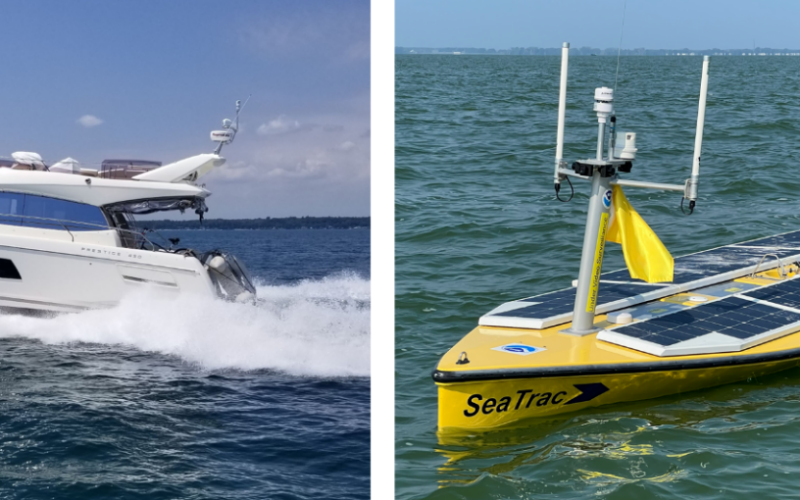
The recommendations stem from an Aug. 10, 2024, collision near Monroe, Mich., involving a 15.7-foot SeaTrac SP-48 USV operated by the National Oceanic and Atmospheric Administration’s Great Lakes Environmental Research Laboratory and a privately owned Prestige 450 Flybridge recreational vessel.
The USV became entangled in the recreational vessel’s starboard propulsion pod, and both vessels were towed together to a nearby marina. One minor injury was reported. The USV was declared a constructive total loss, valued at approximately $186,000, while damage to the recreational vessel was estimated at $100,000.
Investigators found that the USV was difficult for other mariners to see because only about one foot of its hull was visible above the water. The vessel was also unlikely to be detected electronically by the radar or automatic identification systems typically used aboard recreational vessels operating in the area.
The NTSB recommended that SeaTrac Systems, the vessel’s manufacturer, modify its design to improve its detectability. It also called on NOAA to revise its internal policies and require testing to verify that its USVs can be adequately detected by other vessels operating in the same waters.
At the time of the collision, the USV was operating in an “adapted hold” mode, which allowed it to automatically return to preset waypoints if it drifted beyond a 150-foot radius established by its remote pilot. The pilot was passively monitoring the vessel from shore while the system maintained its position.
The NTSB determined that this level of monitoring was insufficient in an area frequented by recreational vessels. It recommended that NOAA establish monitoring requirements based on a USV’s actual level of autonomy, operating mode and surrounding vessel traffic.
More broadly, investigators found that no industry-wide standards specifically addressed the detectability, collision-avoidance capabilities and navigational safety of USVs operating in U.S. inland and territorial waters.
“As USVs become more commonplace in U.S. waterways, it is critical for the Coast Guard to begin to set standards and policies for these vessels,” the NTSB report stated.
The agency recommended that the Coast Guard develop national standards addressing USV detectability, collision avoidance and navigational safety, and incorporate those standards into federal regulations.
