

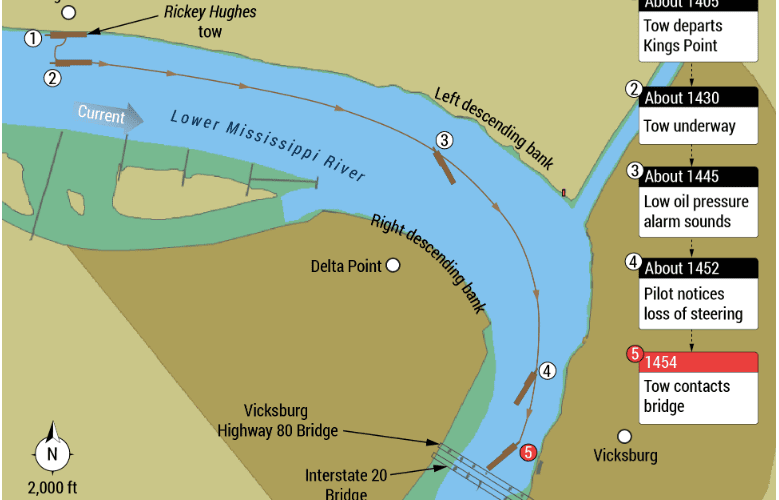
(WASHINGTON) — On May 1, 2025, about 1454, the towing vessel Rickey Hughes was pushing 22 barges downbound on the Lower Mississippi River at mile 435.8 near Vicksburg, Miss., when the two lead barges on the starboard side of the tow contacted a fixed pier of the Vicksburg Highway 80 Bridge. As a result of the contact, seven barges broke away, six were recovered, and one sank. There were no injuries and no pollution was reported. Damage to the barges was estimated at $1.9 million.
The National Transportation Safety Board (NTSB) determined that the probable cause of the accident was a loss of all steering (steering and flanking rudders) due to a crewmember’s misalignment of flanking-rudder system hydraulic valves as he responded to a low-pressure alarm and attempted to restore flanking rudder operation while the tow was approaching the bridge.
Lessons learned
The loss of steering while transiting in channels or maneuvering near immediate hazards (grounding, traffic, objects), when response time is critical, demands crewmembers act quickly to mitigate potential casualties. Vessel steering systems are often designed with automatic backup systems to avoid a loss of steering and therefore, vessel maneuverability during such an emergency. However, some steering systems may require crewmembers to manually change over to standby equipment for steering to be restored. Crewmembers should be familiar with, and trained to use, these systems and their redundancies, including changeover procedures, to ensure they are able to effectively respond in emergency situations.
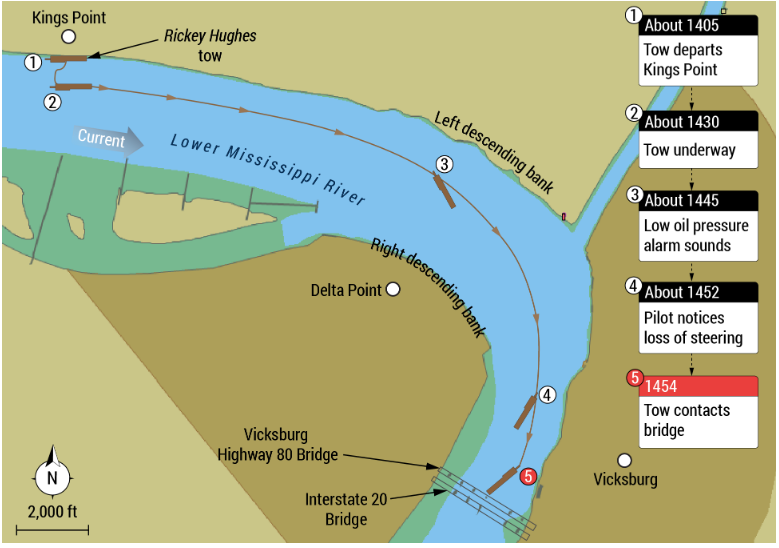
“The loss of hydraulic oil pressure caused an alarm to sound in the pilothouse and engineer’s cabin, awakening the engineer and alerting him to the issue. In response, he went to the rudder room, where he was met by the mate. Responding to the steering emergency, the engineer attempted to restart the flanking rudder system’s hydraulic pump but was unsuccessful,” the NTSB said in its report. “He then attempted to switch over valve alignment so that the flanking rudder hydraulic system would use the auxiliary motor and pump. However, the engineer misaligned the valves, causing hydraulic oil to overflow and erupt through the fill pipe of the flanking rudder reservoir tank and begin covering the deck. As a result, the steering rudder system – which had been operating properly – lost hydraulic oil and subsequently lost pressure.”
“To address the overflowing hydraulic oil, the engineer shut off the power to the steering system motors. Without hydraulic oil or power to the steering system, the steering and flanking rudders could not be moved, and the crewmembers in the pilothouse were left without any steering as they approached the Vicksburg Highway 80 Bridge,” the NTSB said.
Click here to read the complete report.
– National Transportation Safety Board
