

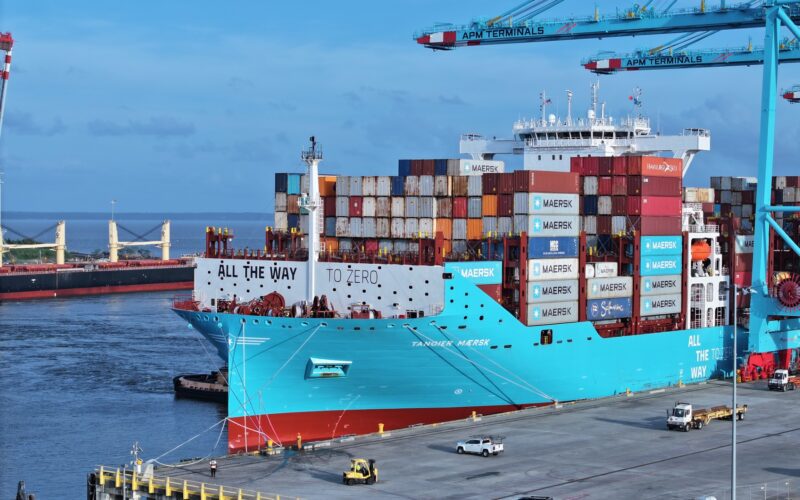
Maersk has completed what it says is the first U.S. bunkering of a vessel with 100 percent bioethanol, using fuel supplied by U.S. bioethanol producer POET.
The dual-fuel containership Tangier Maersk received the U.S.-produced fuel in Houston in what Maersk described as the first ship-to-ship commercial ethanol bunkering of a deep-sea containership in the United States. Kirby Corp. supported the transportation and marine bunkering, while the Port of Houston coordinated the operation and the U.S. Coast Guard supported the regulatory requirements, according to POET.
The operation marked the second U.S. alternative-fuel bunkering first for Tangier Maersk this year. In March, the vessel received about 2,000 metric tons of methanol during what the Coast Guard described as the first vessel-to-vessel methanol bunkering operation in U.S. waters. The Houston bunkering follows a series of Maersk trials examining the use of ethanol aboard vessels designed to operate on methanol and conventional marine fuels. The company has progressively tested ethanol blends before moving to 100 percent ethanol and has conducted previous ethanol bunkering operations outside the United States.
“Bioethanol has the potential to contribute meaningfully to the future energy mix for shipping,” Emma Mazhari, Maersk’s vice president of energy markets, said in a statement. “It can offer another scalable, lower-emission fuel option and greater flexibility in how the maritime industry approaches its transition to lower-carbon fuels.”
Ethanol has emerged as a potential option for alcohol-capable dual-fuel engines because it shares some characteristics with methanol while benefiting from an existing global production and distribution network.
POET, based in Sioux Falls, S.D., produces more than 3 billion gallons of bioethanol annually at 35 U.S. bioprocessing facilities. The company said the Houston operation demonstrates the potential to extend the use of U.S.-produced ethanol beyond its established road-fuel market and into marine transportation.
“Seeing American-made bioethanol move from the farm to a container ship in one of the nation’s largest ports is an exciting moment for our industry,” said Jeff Broin, POET founder and CEO.
The Houston operation also represents another step in Maersk’s effort to broaden the fuels that can be used by its growing fleet of alcohol dual-fuel vessels.
Maersk has invested heavily in methanol-capable tonnage since ordering its first dual-fuel vessel in 2021. The carrier had 19 dual-fuel methanol vessels in its fleet by the end of 2025, with six more scheduled for delivery in 2026. The company has increasingly explored ethanol as another fuel option for those vessels, progressing from 10 percent and 50 percent ethanol blends in 2025 to its first sailing on 100 percent ethanol earlier this year.
Bioethanol’s lifecycle emissions can vary substantially depending on the feedstock and production process, and its lower energy density compared with conventional marine fuels means greater fuel volume is required to provide equivalent energy. Its widespread production and existing supply infrastructure, however, could give it advantages as shipping companies evaluate alternatives to conventional marine fuels.
