

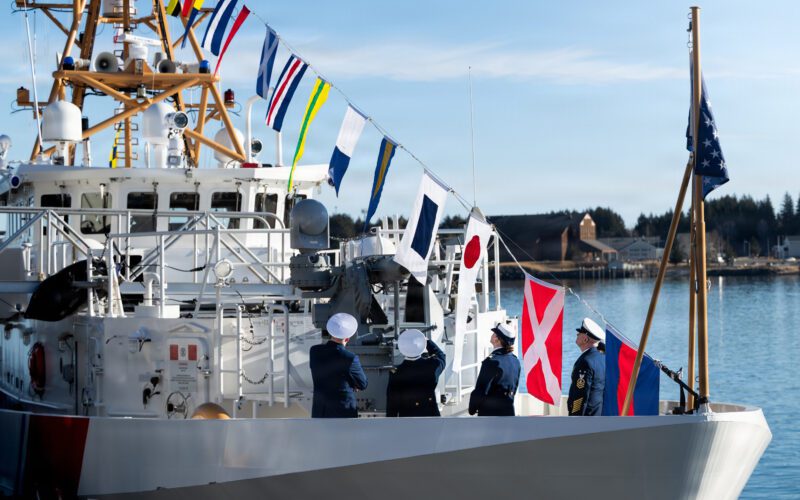
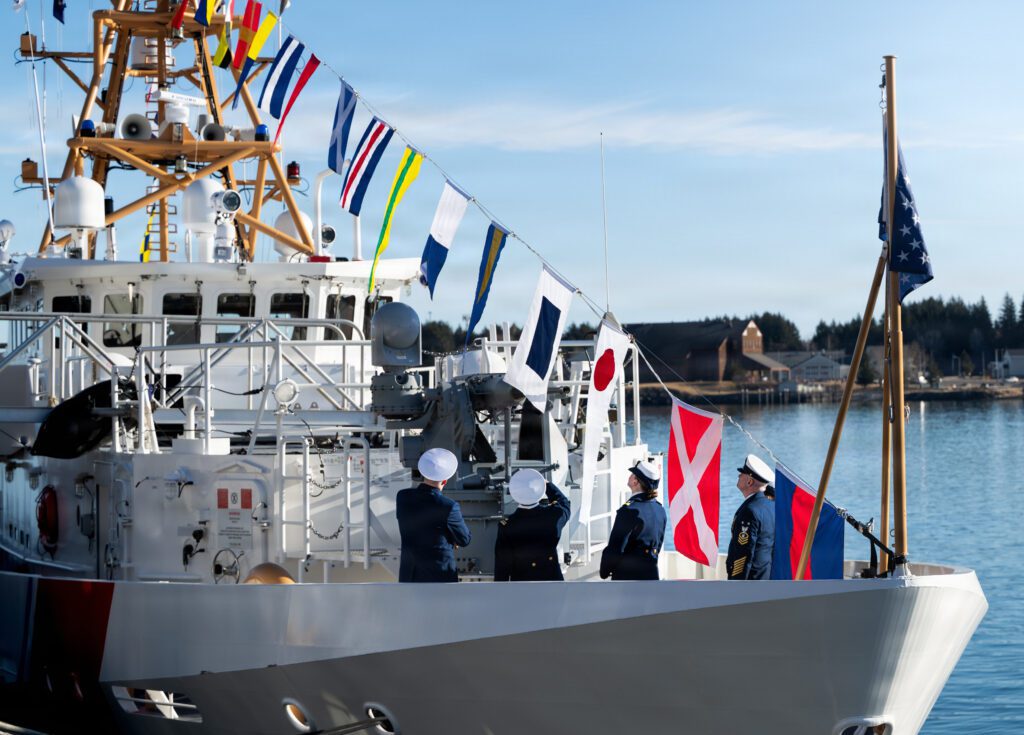
(KODIAK, Alaska) — The U.S. Coast Guard commissioned Frederick Mann, the service’s sixth Arctic District fast response cutter (FRC), during a ceremony Friday in Kodiak, Alaska.
The ceremony was presided over by Rear Adm. Bob Little, commander of the Arctic District. Members of the Mann family were also in attendance, including the cutter’s sponsor, Mrs. Eugenia “Jeannie” Mann Hyder, niece of Frederick Mann.
“Commissioning the Frederick Mann increases U.S. strength and ensures control of our maritime borders and approaches,” said Little. “This crew will honor their motto – courage through fire—as they serve in the U.S. Arctic and Alaska.”
Frederick Mann, built by Bollinger Shipyards, is the Coast Guard’s 60th FRC and the third to be home-ported at Coast Guard Base Kodiak. The crew of the cutter will primarily serve in and around the Aleutian Islands, Bering Sea, Gulf of Alaska, and North Pacific Ocean. The cutter is designed for missions such as search and rescue; fishery patrols; drug and migrant interdiction; national defense; and ports, waterways and coastal security.
Chief Warrant Officer Frederick Mann was born in Atlee, Va., on Oct. 14, 1918, and enlisted in the Coast Guard in 1939. During World War II, Mann’s ship, USS George F. Elliott, participated in the initial landings of Guadalcanal on Aug. 7, 1942. The following day, Japanese bombers attacked the landing fleet and a bomber crashed into his ship, spilling fuel across the decks and setting the ship on fire.
Mann carried a fire hose into the burning ammunition compartment and pumped water into the space. Despite a lack of oxygen, suffocating smoke, and super-heated bulkheads, Mann re-entered the compartment to ensure the hose was dousing the fire and filling the compartment properly. His immediate actions prevented the space from detonating and causing more casualties aboard the ship.
As a direct result, the vessel continued to burn overnight without the ammunition detonating, and everyone was able to safely evacuate the ship. For his heroic actions, Mann was awarded the Gold Life Saving Metal and also received Silver Star and the Presidential Unit Citation.
Afterward, Mann returned stateside and served 31 years in a variety of units including captain of the port (COPT) stations and lifeboat stations on the Great Lakes, East Coast and Gulf Coast. He also served aboard the cutters Bibb and General Greene, and the buoy tenders Myrtle, Oak, White Pine and finally Narcissus, which he commanded.
Mann met his wife, the former Winnie Knox, who served as a SPAR at COTP Miami at the same time as he did. The couple retired to Bayview, Texas, near his last duty station at Port Isabel. They were married for 54 years. Mann passed away at the age of 98 on Jan. 9, 2017.
The Coast Guard has ordered a series of new FRCs to replace the 1980s-era Island-class 110-foot patrol boats. Supported by historic investments made possible through the One Big Beautiful Bill Act, the legislation provides nearly $25 billion – the largest single funding commitment in Coast Guard history – including $1 billion for additional FRCs. This commissioning follows the commissioning of USCGC Storis (WAGB 21) in August, which is the Coast Guard’s first polar icebreaker acquisition in over 25 years. The Arctic District is scheduled to acquire two new offshore patrol cutters in the near future.
– U.S. Coast Guard
