

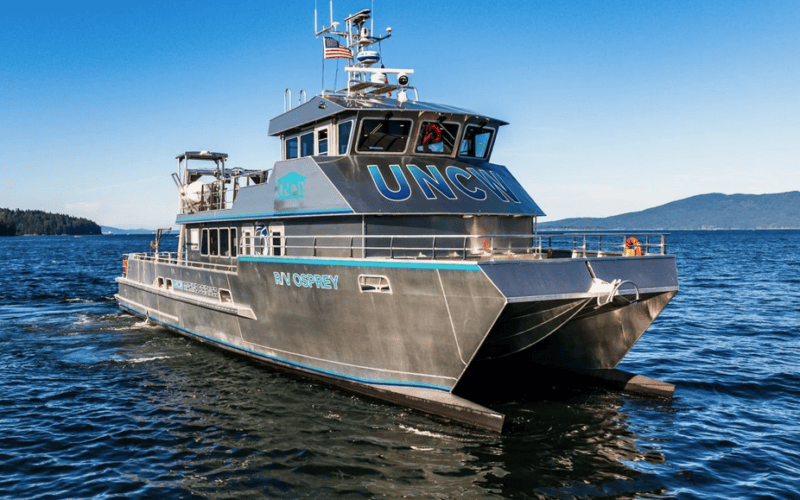
(BELLINGHAM, Wash.) — All American Marine recently shipped R/V Osprey to the University of North Carolina Wilmington, a 78-foot hydrofoil-assisted research catamaran built to U.S. Coast Guard Subchapter T standards and commissioned for supporting scientific and educational missions along the mid-Atlantic and Carolina coast.
Osprey is purpose-built for the full operational range a working research platform demands. Its mission profile includes multibeam and oceanographic survey operations, biological studies, marine mammal monitoring, dive support, and hands-on educational programs for students and faculty. It accommodates live-aboard operations for up to 10 personnel and day-trip capacity for 20.
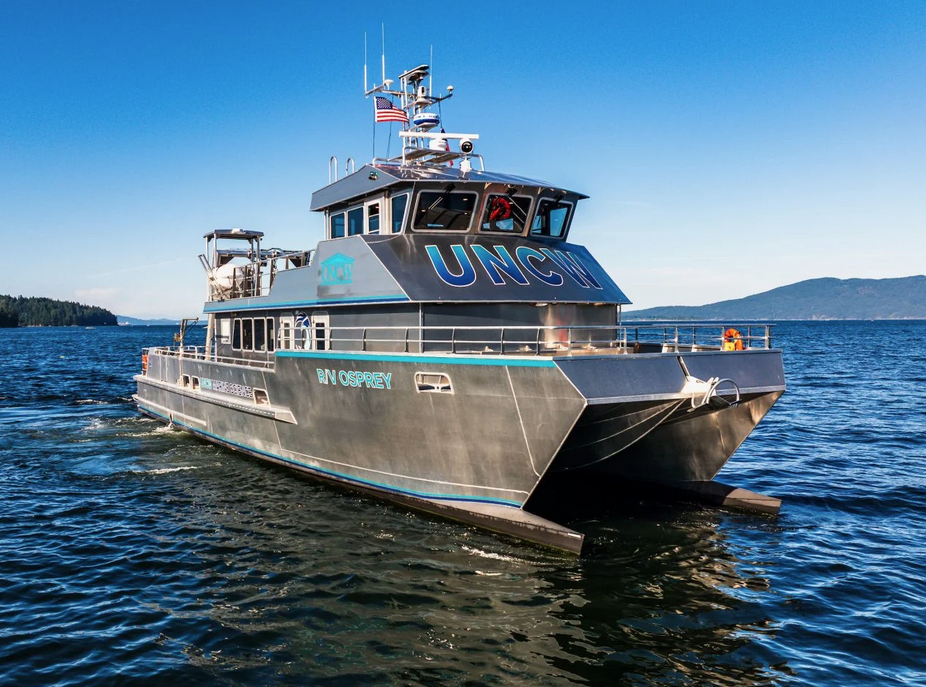
Onboard scientific infrastructure includes a Kongsberg ADCP electronics suite, a fixed WASSP multibeam system, dedicated wet and dry lab spaces, and full equipment deployment and retrieval capability for instrumentation including buoys and autonomous underwater vehicles (AUVs).
But one of the vessel’s most significant results is something operators will see every time they leave the dock: fuel efficiency.
The vessel is powered by twin Scania DI16-082M EPA Tier 3 engines rated at 800 hp, delivering a 22-knot transit speed while maintaining a 1.5-knot survey operation capability. During laden sea trials, the vessel produced All American’s best fuel-efficiency result yet among the closest comparable builds in its size and displacement class.
That result matters because research vessels spend a significant portion of their operating lives getting to and from the work. Every reduction in fuel required for transit lowers operating cost, increases the useful range available from the vessel’s 1,500-gallon fuel capacity, and allows more of the operating budget to go toward the mission rather than getting there.
– All American Marine
