


(VANCOUVER, British Columbia) — The Port of Vancouver moved record volumes of Canadian cargo in the first six months of 2025, delivering made-in-Canada grain, energy and fertilizer exports to diverse world markets against a challenging geopolitical backdrop.
The port’s mid-year cargo statistics show a 13 percent increase in cargo moved between January and June 2025, compared to the same six-month period last year – with a record of more than 85 million metric tonnes (MT) of cargo handled. Port of Vancouver terminals handled nearly 20 percent more international trade than a year ago, with surging exports of Canadian crude oil, canola oil, grain, potash and coal to markets worldwide. Containerized trade over the first half of 2025 remained steady, while cruise and auto volumes eased following record performances in 2024.
“Canadians and their businesses depend on the Port of Vancouver to buy and sell the products they manufacture, farm, mine and stock their shelves with,” said Peter Xotta, president and CEO of the Vancouver Fraser Port Authority. “As Canadians navigate a moment in time like no other, I want to acknowledge the port community and our supply chain partners for rising to the occasion and moving record trade volumes so far this year. The Port of Vancouver has a critical role to play in meeting the moment as Canadian businesses seek to sell more of their products to more customers outside of the U.S.”
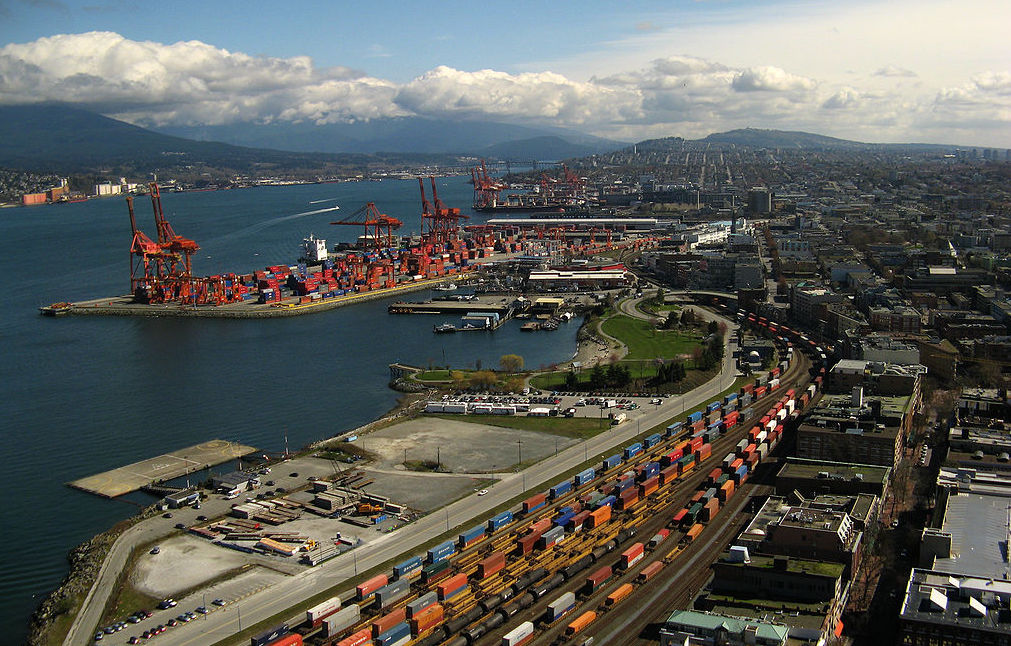
The Port of Vancouver is Canada’s largest and most diversified port – already connecting Canada with more than 170 global economies and moving as much cargo as Canada’s next five largest ports combined. More than 80 percent of the trade through the Port of Vancouver is Canadian trade with countries other than the U.S.
Moving Canadian commodities to new and growing markets
Bulk exports of Canadian commodities were strong in the first half of the year, including record volumes of crude oil exports, and robust volumes of canola oil, grain and potash exports from Manitoba, Saskatchewan and Alberta.
Crude oil exports surged by 365 percent to almost 12 million MT, with Trans Mountain’s expanded pipeline and terminal coming into operation in May 2024. Approximately 60 percent of these record volumes went to China, while other markets including the U.S., South Korea, Singapore and Japan all surpassed their full-year 2024 volumes early in the first half of 2025.
Canola oil exports were up 72 percent to 700,000 MT in the first six months of 2025, as the port connected Canadian producers with new overseas markets and helped offset lower U.S. and Chinese demand. Export markets for canola oil grown throughout Western Canada expanded from four in 2024 (China, U.S., South Korea, Peru) to 12 in the first half of 2025, with new and returning markets including Belgium, Malaysia and Mexico.
Port operators also moved near-record volumes of bulk exports of Canadian grain, fertilizer (potash, sulfur) and coal. Grain was up 8 percent to reach its second-highest half-year volume on record (behind 2021), including wheat up 16 percent and canola seed up 12 percent. Increased volumes of canola seed went to Japan, while new markets such as Mexico, Netherlands, France, Bangladesh and Bulgaria helped offset the impact of Chinese tariffs.
Potash was up 26 percent to reach its second-highest half-year result on record after 2019 as the fertilizer product recovered from a slowdown in 2024, while sulfur was up 5 percent and coal down 2 percent.
“For decades, and prior to tariff threats, along with our partners we’ve been working hard to grow trade capacity to meet demand. Today, our growth plans and partnerships are purpose built to help Canada rise to the occasion and get made-in-Canada products to more customers,” said Xotta. “We all win when we work together. For example, we’re using new tech and tools to facilitate thousands of ship movements a year – allowing us to improve visibility in how goods are moving through the port, better coordinate with supply chain partners and add capacity. Our Active Vessel Traffic Management Program, combined with ongoing collaboration, has meant the port has been able to smoothly integrate Trans Mountain’s expanded volumes over the past year while also enabling CN (Canadian National) to increase rail service to the busy North Shore trade area by 10 percent.”
Container sector stable, unaffected by U.S. tariff slowdown
The Port of Vancouver’s four container terminals moved 1.88 million 20-foot equivalent units (TEUs) at mid-2025, with mid-year volume growth of 6 percent driven largely by Canadian trade. It was the second-highest volume of containers moved at mid-year, after 2021’s record of 1.94 million TEUs.
“Containerized trade – like the Canadian economy – has shown remarkable strength and resilience so far this year in the face of U.S. tariffs and global uncertainty,” said Xotta. “More and more, we are seeing Canadian businesses turn to containers to securely trade goods with world markets. With containerized trade through the port on a long-term growth trajectory, Roberts Bank Terminal 2 is uniquely positioned to deliver for Canada. We are advancing toward a final investment decision soon for the nation-building project, which will unlock an additional $100 billion a year in West Coast trade capacity and enable Canadian businesses to win even greater market share overseas.”
Auto imports and cruise passenger visits ease from record years
The Port of Vancouver’s cruise sector had just over 130 cruise ship calls and 500,000 passenger visits between March 5 and June 30 – down compared to 2024’s record-breaking year, but still strong as Canada Place cements itself as one of North America’s premier home ports.
“Canada Place is now regularly seeing upwards of 300 cruise ship calls and 1.2 million passenger visits every year – injecting around $1 billion into the economy and supporting jobs and local businesses throughout the region,” said Xotta. “We are honored to partner with countless cruise and destination partners to ensure Canada Place remains a premier home port serving the popular Alaska market – together we are making Vancouver cruise shine and creating jobs for Canadians.”
Each cruise ship visit to the Canada Place cruise terminal at the Port of Vancouver injects about $3 million into the local economy, according to an Economic Impact Study released by the port authority in 2024.
Auto volumes eased 3 percent to 241,000 units, down slightly compared to last year’s record and the third-highest volume for the port. Nearly 100 percent of Canada’s Asian-manufactured vehicle imports arrive via the Port of Vancouver, with work to optimize the Annacis Auto Terminal and increase its capacity by one-third being completed earlier this year.
Foreign break-bulk volumes were down 8 percent due to forestry exports continuing a trend toward containers and metal imports falling slightly.
Domestic volumes – largely comprised of local movements of logs, sand and gravel – decreased.
– Vancouver Fraser Port Authority
